Many organizations choose Nextcloud to gain greater control over their data and collaboration environments. However, running and maintaining a Nextcloud deployment requires ongoing administration, making managed hosting an attractive option for many businesses.
Not all managed Nextcloud providers offer the same level of security, reliability, support, or flexibility. In this article, we discuss the key factors to consider when evaluating providers and selecting a solution that aligns with your organization's needs.
Key Takeaway
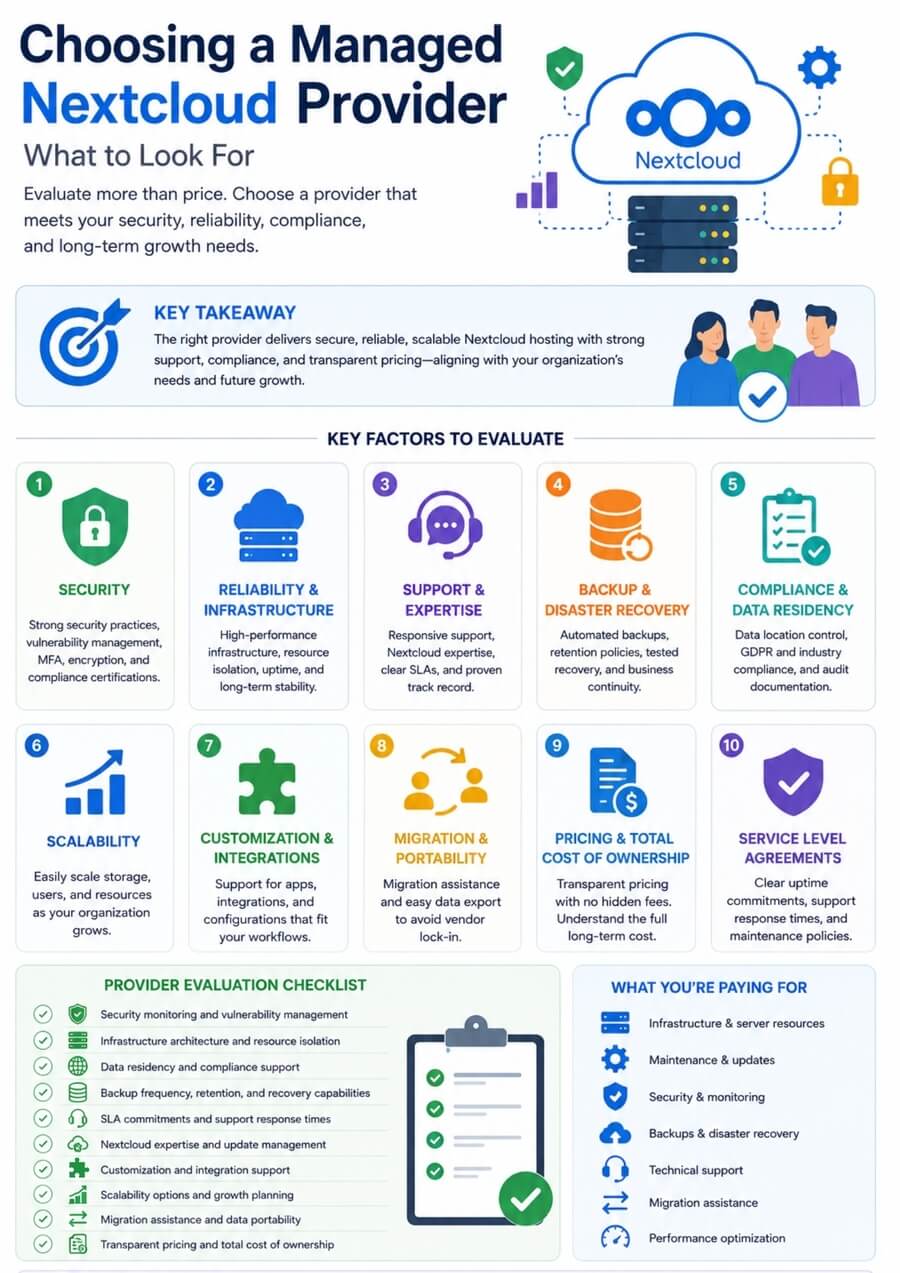
When choosing a managed Nextcloud provider, evaluate more than storage capacity and monthly pricing. Compare providers based on their security practices, infrastructure reliability, backup and disaster-recovery capabilities, technical support, customization options, scalability, data residency policies, compliance support, service-level commitments, and total cost of ownership. The right provider should align with your organization's operational, regulatory, and long-term growth requirements while delivering reliable service and ongoing platform expertise.
Managed Nextcloud Hosting: Understanding What You Are Actually Paying For
When evaluating managed Nextcloud hosting, it is important to understand that you are paying for more than server resources and storage capacity. A self-hosted deployment requires your team to handle the ongoing operation of the platform, including maintenance, updates, monitoring, backups, troubleshooting, and security management. Managed hosting transfers much of that responsibility to a specialized provider, reducing the operational burden on internal teams.
The value of a managed service lies in the expertise and support that come with the platform. Depending on the provider, this can include infrastructure management, technical support, migration assistance, performance optimization, backup administration, and other services that help keep the environment stable and reliable.
Because service offerings can vary significantly, organizations should evaluate what is included beyond the hosting environment itself when comparing providers.
Security: Beyond Encryption and MFA
Security is one of the most important factors when evaluating a managed Nextcloud provider, but it should not be reduced to a checklist of platform features. While capabilities such as encryption, access controls, and multi-factor authentication are important, most reputable providers already support them. The bigger question is how the provider protects and manages the environment behind the platform.
A provider's approach to vulnerability management, software updates, system monitoring, and compliance often reveals more about its security posture than a list of advertised features. Understanding how security is maintained on an ongoing basis can help organizations identify providers that are prepared to protect sensitive data and respond effectively to emerging risks.
Organizations with strict security requirements may also wish to review whether a provider maintains independent certifications or audit reports, such as ISO 27001 or other relevant compliance frameworks, where applicable.
Hosting Infrastructure and Service Reliability
The quality of a provider's infrastructure can directly impact the performance and reliability of a managed Nextcloud environment. While hosting plans may appear similar on paper, differences in resource allocation, storage architecture, and overall platform design can significantly affect user experience.
Providers that rely heavily on shared resources can experience performance fluctuations during periods of high demand, while resource-isolated environments may provide more predictable performance as workloads grow.
Infrastructure should also support long-term growth without compromising stability. As storage requirements, user counts, and collaboration activity increase, organizations need confidence that the platform can scale without disruption. When evaluating providers, look beyond storage capacity and uptime claims to understand how the environment is designed to maintain performance, availability, and reliability over time.
Service Level Agreements (SLAs) and Support Commitments
Service level agreements can provide valuable insight into how a provider approaches reliability and customer support. While uptime percentages often receive the most attention, organizations should also review support response targets, escalation procedures, maintenance policies, and any service credits offered when commitments are not met.
A clear SLA helps set expectations and provides greater transparency regarding the level of service an organization can expect over time.
Data Residency and Compliance Requirements
Organizations subject to regulatory, contractual, or internal governance requirements should understand where their data is stored and which jurisdictions apply to the hosting environment. Data residency can affect compliance obligations, privacy requirements, and the level of control organizations maintain over sensitive information.
Providers should be transparent about data center locations, data handling practices, and any third parties involved in delivering the service.
Compliance considerations vary by industry and region, but organizations should verify that the provider can support their specific requirements. Depending on the organization, this may include GDPR compliance, data residency obligations, industry-specific regulations, audit documentation, or data processing agreements. Evaluating these requirements early can help prevent compliance challenges and costly migrations later.
Backup and Disaster Recovery Capabilities
A provider's approach to backups and disaster recovery can significantly impact business continuity during outages, security incidents, or accidental data loss. When evaluating managed Nextcloud services, look beyond whether backups are performed; examine how often they occur, how long data is retained, and what recovery options are available. These details determine how effectively data can be recovered when problems arise.
Equally important is the provider's ability to restore services quickly and reliably. Recovery procedures should be documented, regularly tested, and supported by infrastructure designed to minimize disruption during unexpected events.
Providers that combine dependable backup practices with a documented disaster recovery strategy are often better positioned to support business continuity and protect critical business data.
Technical Support and Nextcloud Expertise
The quality of technical support can significantly influence the long-term success of a managed Nextcloud deployment. When evaluating providers, consider more than support availability and response times. The ability to access knowledgeable specialists who can quickly diagnose issues, resolve problems, and provide guidance when needed is often just as important as the infrastructure itself.
Experience with Nextcloud should also be a key consideration. Providers that specialize in managing Nextcloud environments are often better positioned to troubleshoot platform-specific issues, optimize performance, support integrations, and assist with deployment or migration projects. Reviewing a provider's experience, customer references, and track record can help determine whether they have the expertise needed to support your organization over the long term.
Organizations should also evaluate how providers manage Nextcloud version upgrades, security patches, and maintenance windows. A well-defined update process can reduce risk and help ensure the platform remains secure and stable.
Customization and Integration Capabilities
One of Nextcloud's key advantages is its flexibility, but not all managed providers offer the same level of customization. Some restrict application installations, integrations, or configuration changes to simplify management, while others provide greater control over how the platform is deployed and used.
When evaluating providers, confirm they can support the applications, workflows, and operational requirements important to your organization.
Integration capabilities are equally important. Many organizations rely on identity management systems, productivity platforms, communication tools, and other business applications that must work seamlessly with Nextcloud.
A provider that supports the necessary integrations and customization options can help ensure the platform fits naturally into existing processes rather than creating new administrative challenges or workflow limitations.
Scalability and Growth Planning
A managed Nextcloud provider should be able to support not only your current requirements but also future growth. A deployment that performs well for a small team may face new demands as user counts, storage needs, and collaboration activity increase. Evaluating how providers handle resource expansion can help prevent the need for disruptive migrations or service changes as your organization evolves.
Scalability extends beyond adding storage or users. As operational requirements become more complex, organizations may require additional integrations, compliance capabilities, dedicated resources, or enhanced support services.
Migration Assistance and Vendor Lock-In Considerations
Organizations should understand how easily they can migrate data into and out of a managed Nextcloud environment. While migration support is often available, the level of assistance varies between providers. Reviewing migration processes in advance can help reduce risk during implementation and future platform changes.
It is also worth understanding whether any proprietary tools, configurations, or service limitations could make future migrations more difficult. Evaluating portability early can help organizations maintain flexibility as requirements change.
Pricing Transparency and Total Cost of Ownership
Pricing should be evaluated in the context of the overall service rather than the advertised monthly fee alone. While storage limits and base pricing are easy to compare, the long-term cost of a managed Nextcloud solution often depends on what is included and what requires additional charges.
Before making a decision, review how the provider handles costs related to storage expansion, premium support, migration assistance, backup retention, and other add-on services. Transparent pricing structures reduce the risk of unexpected expenses and make it easier to estimate the total cost of ownership over time.
In many cases, a provider that appears more expensive upfront may deliver better long-term value than a lower-cost alternative with limited services or additional fees.
Provider Evaluation Checklist
- Security monitoring and vulnerability management processes
- Infrastructure architecture and resource isolation
- Data residency and compliance support
- Backup frequency, retention, and recovery capabilities
- SLA commitments and support response times
- Nextcloud expertise and update management procedures
- Customization and integration support
- Scalability options and growth planning
- Migration assistance and data portability
- Transparent pricing and total cost of ownership
Conclusion
Choosing a managed Nextcloud provider involves more than comparing storage limits or monthly pricing. The right provider should be able to support your organization's security requirements, operational needs, growth plans, and long-term objectives while delivering reliable service and expert support.
Because managed providers can differ significantly in their infrastructure, service offerings, compliance capabilities, and level of expertise, it is important to evaluate each option carefully. Assessing these factors early can help organizations avoid unnecessary limitations, reduce operational risk, and select a solution that continues to meet their needs as requirements evolve.
Creating a requirements checklist before comparing providers can make the evaluation process more structured and help ensure that critical business, technical, and compliance requirements are not overlooked.